
The Supreme Court recently held that an accused person does not have a right of appeal against interlocutory orders issued by the Permanent High Court-at-Bar. The Court described the appeal filed in this case as a misuse of the appellate process aimed at delaying the trial, and reaffirmed that such practice must be firmly discouraged. …
No Right of Appeal for Accused on Interlocutory Orders from High Court-at-Bar – SC
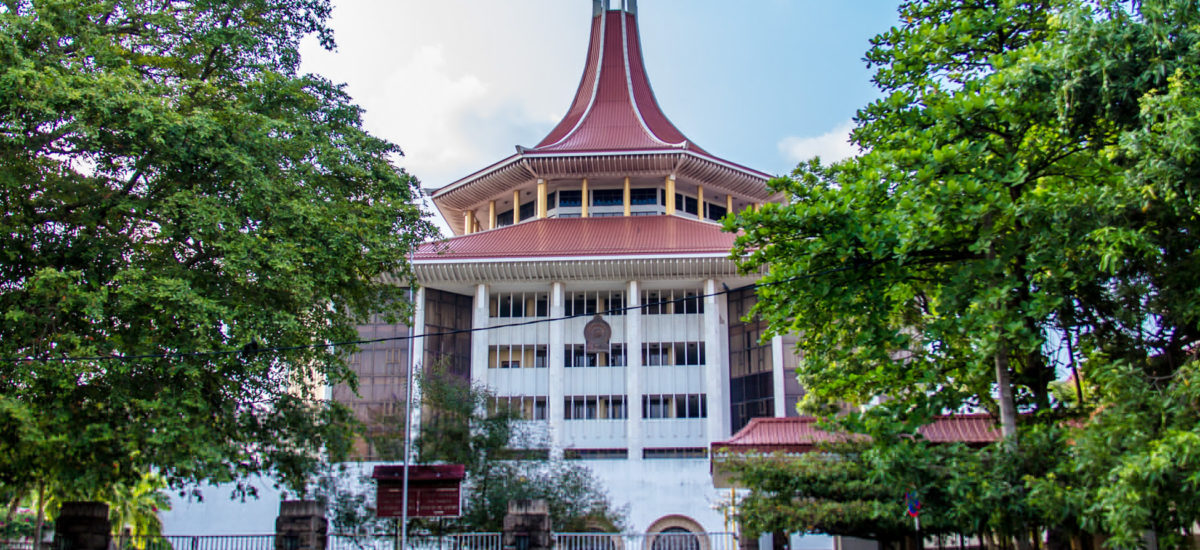
The Supreme Court recently held that an accused person does not have a right of appeal against interlocutory orders issued by the Permanent High Court-at-Bar. The Court described the appeal filed in this case as a misuse of the appellate process aimed at delaying the trial, and reaffirmed that such practice must be firmly discouraged.
The case involved former Finance Minister Ravi Karunanayake and businessman Arjun Aloysius, who were indicted under the Bribery Act by the Commission to Investigate Allegations of Bribery or Corruption (CIABOC). The indictment alleged that Karunanayake, while serving as Minister of Finance, accepted unlawful gratification in the form of rent payments for a luxury apartment, “Monarch Housing Complex”, on behalf of his family, from Aloysius, whose company was at the time under scrutiny in the Central Bank bond scandal.
CIABOC filed the indictment under the Bribery Act, charging Karunanayake with accepting a bribe, and Aloysius with aiding and abetting the offence. The Permanent High Court-at-Bar overruled Karunanayake’s preliminary objection, in which he claimed he was not a “public officer” within the meaning of the law, and fixed the case for trial.
Karunanayake then sought leave to appeal against that interim ruling before the Court of Appeal. The Court of Appeal thereafter granted leave. However, the Supreme Court set aside the Court of Appeal’s order granting leave, concluding that there was no legal basis for such an appeal to be entertained, and characterizing the attempt as a deliberate effort to derail the prosecution.
The Supreme Court made it clear that the Constitution does not itself confer a right of appeal, and such a right must arise strictly from statutory provisions. The Court cited the judgment in Thennakoonwela v. Director General, CIABOC [SC TAB No. 4/2023], which confirmed that Section 12B(1) of the Judicature Act does not grant an automatic right of appeal from interlocutory orders made by the High Court-at-Bar.
“…Thus, a divisional bench of this Court has already held that an accused indicted before the Permanent High Court-at-Bar does not have a right of appeal against an interlocutory order made by such High Court. Although the issue before Court in Thennakoonwela related to the analysis and interpretation of Section 12B of the Judicature Act, this Court had also analysed the scope and width of Sections 14, 15 and 16 of the Judicature Act, which are the three Sections of the Judicature Act which arise for consideration on in this appeal, and concluded that an accused does not have a right of appeal against any interim order of a High Court in terms of those sections, as well…” – Justice Arjuna Obesekere
The Supreme Court emphasised that allowing such appeals would paralyse the trial process, with cases being held up at every procedural stage. Quoting Martin v. Wijewardena (1989) 2 Sri LR 409, the Court underscored:
“…I may also add that raising frivolous objections and thereafter invoking the appellate jurisdiction of either this Court or the Court of Appeal with a view of delaying the wheels of justice from turning is a phenomenon that has emerged within the criminal justice system in the recent past, and very unfortunately, is fast becoming a regular practice…”- Justice Arjuna Obesekere
Director General of CIABOC ‘Necessary Party’ in Bribery Appeals
The Supreme Court further clarified that in bribery-related appeals, the Director General of CIABOC is a necessary party, given his statutory role in initiating prosecution. The judgment cites Sections 11 and 12(1) of the CIABOC Act No. 19 of 1994, which empower the Commission to direct the Director General to institute proceedings and treat his indictment as equivalent to one presented by the Attorney-General.
“…In Kesara Senanayake v Attorney General and another [(2010) 1 Sri LR 149; at page 162] the appellant had named the CIABOC as a party to the appeal but not its Director General. On an objection raised that proceedings have been instituted by the Director General and therefore the Director General is a necessary party to the appeal and should have been named as a respondent, Shirani Bandaranayake, J (as she was then) considered inter alia the above provisions of Act No. 19 of 1994 and held that institution of proceedings are carried out by the Director General of CIABOC on the directive of CIABOC, and thus, “it is evident that the Director-General has to be regarded as the complainant in such an application and therefore is a necessary party to this appeal.” – Justice Arjuna Obesekere
MPs and Cabinet Ministers Are Subject to the Bribery Act-Article 170 Does Not Override
Karunanayake’s counsel argued that under Article 170 he was not a constitutional “public officer” and thereby immune from prosecution under the Bribery Act. The Court held that Article 170 is solely meant for constitutional provisions and does not affect statutory definitions. Under the Bribery Act, as amended, Cabinet Ministers and MPs are expressly included as “public servants” or “public officials.” The Supreme Court confirmed that Karunanayake was properly chargeable under the Bribery Act, and Article 170 does not confer immunity.
“…I must reiterate that there can be no doubt that a Minister of the Cabinet of Ministers and everyone else referred to in the definition of ‘public servant’ found in the Bribery Act, as amended is a ‘public servant’ for the purposes of the Bribery Act, and that proceedings can be instituted against all such persons including a Minister of the Cabinet of Ministers for an offence committed under the Bribery Act. The position is the same under the Anti-Corruption Act, as well…”- Justice Arjuna Obesekere
Case No: SC Appeal No. 61/2024 [Decided on 30.05.2025]
Before: E.A.G.R. Amarasekara, J A.H.M.D. Nawaz, J and Arjuna Obeyesekere, J