SC rules partition case was a disguised attempt to gain wider road access
You Can’t Leave Out Co-Owners and Ask to Divide Just Your Part
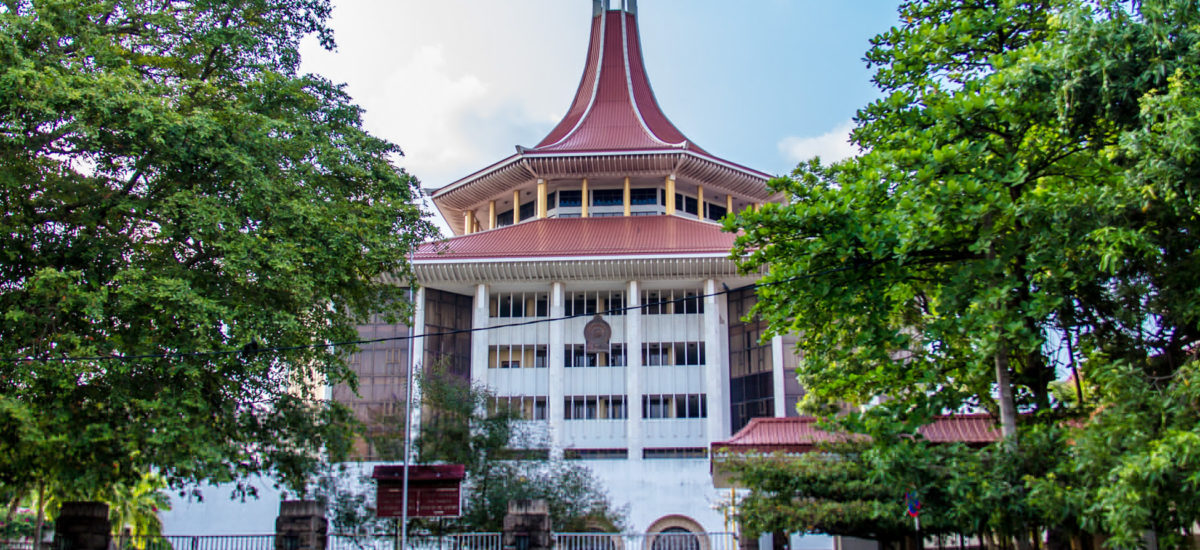
The Supreme Court has rejected a partition action filed by two individuals who sought to divide only a portion of a larger land, while deliberately leaving out a co-owner. The Court found that the real aim of the case was not to partition the land, but to claim a wider road access. Highlighting that the law does not permit the partition of part of a land when co-ownership of the whole exists, the Court stressed that judges are not expected to go on a “voyage of discovery” to uncover omitted titles. Instead, it is the duty of plaintiffs to disclose all known owners and establish a clear title before filing such an action.
This case centered around a land originally measuring 26 perches, based on a survey plan from 1942. In 1974, the original owner gifted 15 perches from this land to another party through a registered deed. This gift included a portion of a house and specifically reserved a 5-foot-wide path along the eastern boundary to give access to the remaining portion of the land.
Several years later, in 1983, the same original owner gifted the remaining 11 perches to two individuals. These two recipients had always accessed their land via the 5-foot-wide path that had been reserved in the earlier deed.
However, many years later, these two individuals filed a partition action—not to partition the entire 26 perches, but only their 11-perch portion. In doing so, they completely left out the co-owner who had been gifted the 15 perches decades earlier. They argued that their survey plan mentioned a 10-foot-wide road reservation, and on that basis, asked the court to partition their portion with 10-foot road access.
The District Court rejected their case. It found that this was not a genuine partition action, but rather an attempt to use partition law to gain a wider access road by deliberately excluding the rightful co-owner. The court emphasized that partition law does not permit a party to seek division of just a portion of the land, especially when there are known co-owners who are not included in the case. It also noted that if the plaintiffs had carried out a proper land registry search, they would have found the earlier deed granting 15 perches and reserving only a 5-foot path.
The plaintiffs appealed to the Provincial High Court, which overturned the District Court’s ruling. The High Court took the view that courts have a duty to examine the title of all parties, and therefore the trial judge should have proceeded with the partition despite the plaintiffs’ omissions.
However, the Supreme Court disagreed and reinstated the District Court’s decision. The apex court carefully reviewed the evidence and stated that this was not simply a mistake or oversight by the plaintiffs. Instead, it appeared they had deliberately excluded the co-owner in an attempt to secure a 10-foot-wide road, when they had always used and been given only a 5-foot-wide path.
“…It is clear from the learned District Judge’s judgment that the learned District Judge has correctly identified the law relating to a partition action. It has been determined that the plaintiffs have failed to follow the necessary provisions of Partition Law when instituting the partition action, and that there is no possibility for the Court to partition only a portion of a land as claimed by the plaintiffs. It has also been determined that the real purpose of instituting this action had been to obtain a 10-foot-wide right of way over the land, in the guise of a partition action, and that there is no basis for such a determination…” – Justice Sampath B. Abayakoon
The Court emphasized that a partition action must include the whole land and all known co-owners. The plaintiffs had failed to state that they were unaware of any other owners, nor did they ask for unclaimed shares to be left unallocated. They presented their case as if they alone were entitled to the 11 perches, knowing full well that someone else held title to the rest.
The Supreme Court also clarified that the 10-foot road shown in the old plan was a reservation and not part of the actual land lots (Lots A and B). This road was located outside the boundaries of the 26 perches. The plaintiffs had no legal basis to claim that as their own or to demand 10-foot access through it.
The Court noted that the true intention behind this partition case was not to divide land fairly but to secure a wider road than what had been lawfully granted. The Supreme Court, therefore, set aside the High Court’s decision, upheld the original judgment of the District Court, and dismissed the partition action. The two plaintiffs were also ordered to pay costs.
In the case of Girigoris Appuhami Vs. Maria Nona 60 NLR 330, it was determined that; “Where a land is possessed in different portions by different co-owners for convenience of possession a partition action cannot be maintained in respect of one portion only; the entire land should be brought into action.”
It is trite law that in a partition action, it is the duty of the trial Judge to investigate title and come to a finding with regard to the rights of the parties. However, it is my considered view that a trial Judge cannot be expected to go on a voyage of discovery in the guise of examination of title. It was held in the case of Thilagaratnam Vs. Athpunathan and Others (1996) 2 SLR page 66; 1. Although there is a duty cast on Court to investigate title in a partition action the Court can do so only within the limits of pleadings, admissions, points of contest, evidence both documentary and oral.
Per Ananda Coomaraswamy, J., “We are not unmindful of these authorities and the proposition that it is the duty of the Court to investigate title in a partition action but, the court can do so only within the limits of pleadings, admissions, points of contest, evidence both documentary and oral. Court cannot go on a voyage of discovery tracing the title and finding the shares in the corpus for them, otherwise parties will tender their pleadings and expect the Court to do their work and their Attorneys-at-Law work for them to get title to those shares in the corpus.”
– Justice Sampath B. Abayakoon
Case No: SC APPEAL NO. 44/2020 [Decided 30.05.2025]
Before : A.L. Shiran Gooneratne, J. : Janak De Silva, J. : Sampath B. Abayakoon, J.